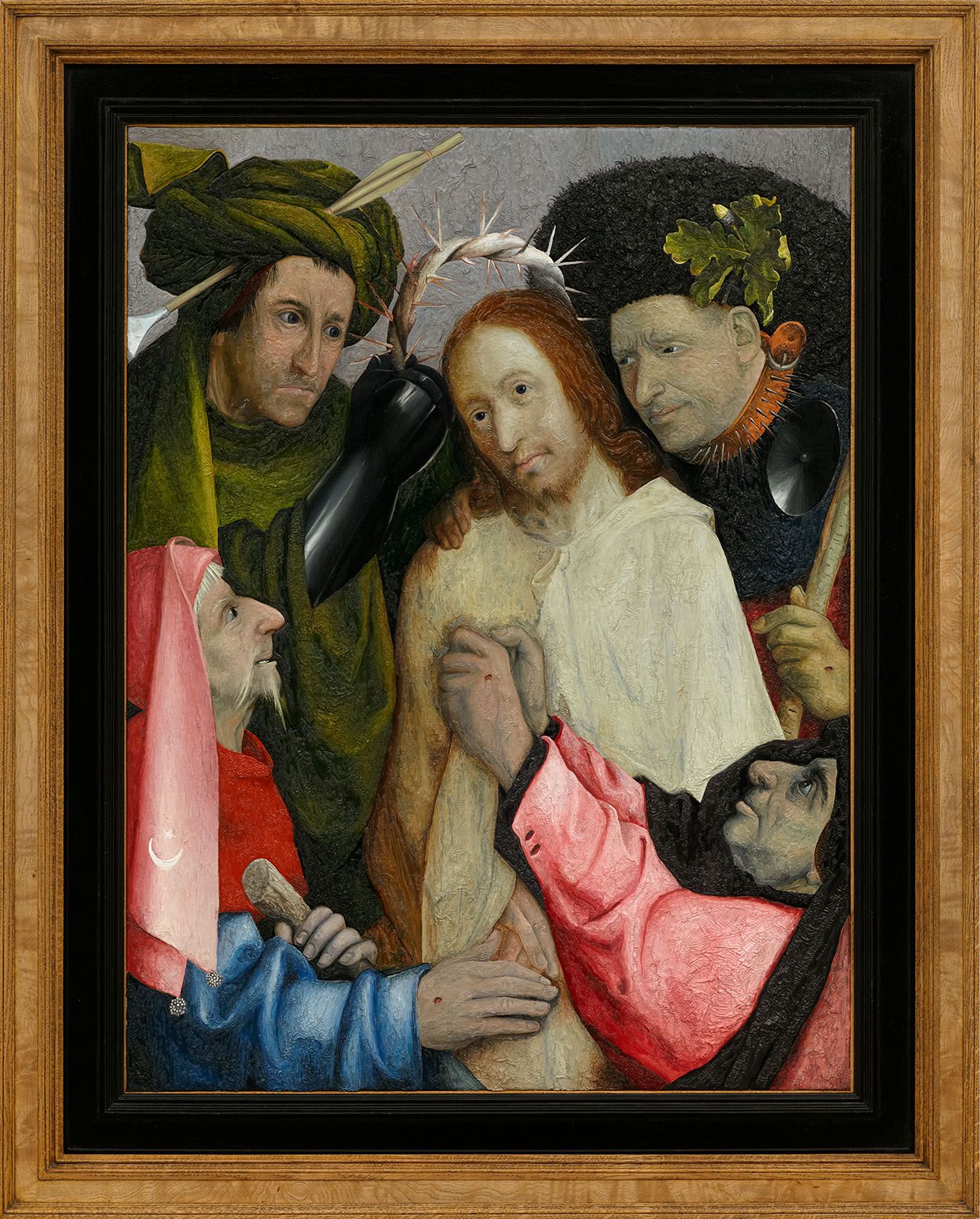
After Bosch’s Christ Crowned with Thorns, also known as Christ Mocked, this painting retains the brutal symmetry of the original, Christ surrounded, scrutinised, condemned, but introduces a subtle and devastating transformation. Over time, the surface itself begins to wrinkle and warp. The image does not merely depict suffering; it absorbs it physically.
The original, painted around 1490, was a meditation on cruelty, conviction, and divine silence. This version, rendered in thick oil, is made under contemporary conditions, in which images circulate at speed and belief is subjected to constant pressure. The body of the painting, however, still changes slowly. Its distortions accumulate over time, as the surface registers duration, exposure, and stress.
It is within that tension that a question emerges. Can belief endure when its images are accelerated, mediated, and endlessly exposed, even as their material bodies degrade at a human pace? Can the sacred survive when surfaces are no longer stable, but continuously processed and worn down? The work does not answer these questions. It allows them to form through material change.
The painting suggests not disappearance, but mutation. The face remains, but what it once promised, truth, stillness, transcendence, is unsettled and unresolved. As in The Icarus Stain or Wrestling with Angels, this is not loss, but a reckoning.
And yet something does remain. Not certainty, not doctrine, but a residue of attention. Like the stone figures in Philip Larkin’s Arundel Tomb, what survives is not belief as structure, but belief as care. Something held quietly, beyond image and surface.